Lesson 2
Have a look at the tablature below. Before you do anything listen carefully to the track. Listening is the most important part of learning music.
There are three versions of this track:
Demonstration
This is the part you will learn, played without any accompaniment so you can clearly hear how it should sound.
Backing Track
This is the accompaniment to the tune. You can play along to this as though you are part of the band.
Full Performance
This is both parts put together so that you may hear the composition in it's entirety.
Listen carefully to the Full Performance and Solo Guitar. Look at the tab below and follow the music along with your eyes as you listen.
2. Takin' It Easy

These are repeat marks. Everything written within them should be played again. In this case, that's the whole tune.
Numbers are used to represent frets. The tablature below says to play the 1st fret. It is written on the first line, which represents the 1st string. Try this now.
Now repeat the same process and learn to play Étude with Attitude.
Ask your teacher/friends/family to critique you. Remember, there is always room for improvement. Don't expect to be able to play anything in this book first time. Everything here will take practice.
Try to copy what you hear exactly. Take a careful note of the rhythm and let each note ring out clearly, just as you hear on the performance.
Introduction to Chords
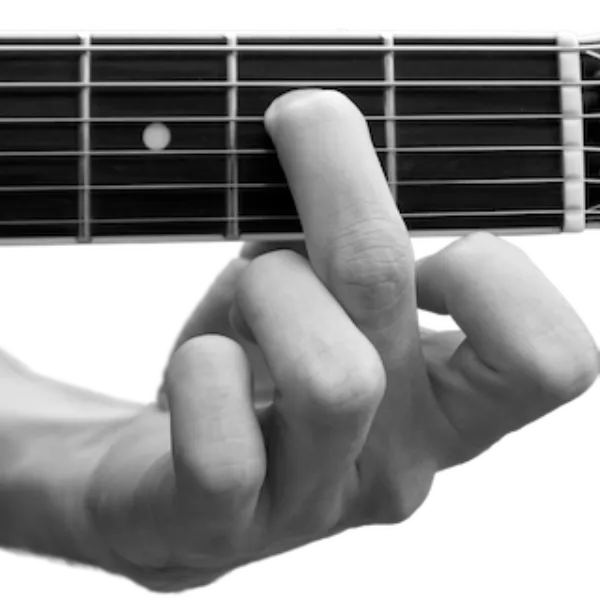
This is a chord diagram, which is very similar to tablature. The diagram represents the neck of your guitar as it is positioned in the photograph.
A chord is a group of three or more notes played simultaneously. Each chord has a name and it is important to learn it.
Fingers are represented by a circle placed on the corresponding string and fret. The number written within the circle tells you which finger to use.
If an open string is to be played an o is placed above the string. If a string is not to be played an x is placed above the string.
Look at the diagram below and play a G chord. Use the photo to help. All the notes on the diagram should be strummed simultaneously. To do this, first position your fretting hand correctly, then, rest your plectrum on the 4th string and strum down over the strings so that they all ring out at once.
Make sure your second finger does not touch any of the other strings that make up the chord, as it will stop them from ringing. This means your finger should be arched so that the strings can pass freely under it.
A Minor Consideration
There are two main types of chord. Major and minor. The difference between them is that a major chord sounds happy while a minor chord sounds sad. When talking about chords we often disregard the word major, therefore if you see a chord symbol which neither says major or minor, assume that it is major. Minor chords will always be preceded with the word minor or a lower case m. For example, E minor or Em.
G Chord

Em Chord
Practice Makes Perfect
Or rather, perfect practice makes perfect. To really make the most out of this book I want you to follow these guidelines to practising the material within it. I promise they are not difficult, in fact, I've done my utmost to make the process as effortless as possible.
In each chapter of this book you will find this symbol alongside some of the headings. This indicates how many minutes you should include the topic into your practice routine for. Yes, I'd really like you to have a practice routine. It's not as heavy as it sounds - it's actually incredibly easy and it will have the effect of making the time you spend practising as effective as it can be.
Action
Spend one minute every day on each topic in Chapter 2. You have two things to practice for one minute each: Repertoire and Chords. Aim to work on each chapter for approximately a week or two. You don't have to practise each topic back to back. You could do one minute of Repertoire after breakfast, and one minute of Chords after dinner. The important part is that you do it every day! If you want to do more after the one minute is up that's great, go for it, just as long as you don't consider it a requirement. The reason is, if you decide you're going to do half an hour every day it becomes challenging, so your chances of success are diminished- which is demotivating. So just set your target at one minute per topic and see to it that you absolutely definitely do it.
I worked hard. Anyone who works as hard as I did can achieve the same results.